
Every school morning in Pakistan, millions of children sing a prayer that begins “Lab pe aati hai dua ban ke tamanna meri.” Most of them learn it before they can read it. The man who wrote it was a lawyer, a philosopher with a German doctorate, a politician and, above all, a poet who wrote in two languages. He died nine years before Pakistan was created, yet the country calls him its national poet and the “Thinker of Pakistan”.
This is the story of Allama Muhammad Iqbal: where he came from, what he wrote, and why his verses still matter a century later.
Quick facts
| Full name | Muhammad Iqbal |
|---|---|
| Known as | Allama Iqbal; Shair-e-Mashriq (Poet of the East); Hakeem-ul-Ummat; Mufakkir-e-Pakistan |
| Born | 9 November 1877, Sialkot, Punjab |
| Died | 21 April 1938, Lahore |
| Resting place | Beside the Badshahi Mosque, Lahore |
| Languages of his poetry | Urdu and Persian |
| Best-known works | Bang-e-Dara, Bal-e-Jibril, Zarb-e-Kalim (Urdu); Asrar-e-Khudi, Payam-e-Mashriq, Javid Nama (Persian) |
| Central idea | Khudi: selfhood, self-respect and the growth of the self |
Childhood in Sialkot
Iqbal was born in Sialkot on 9 November 1877. Older books sometimes give 1873 or 1876, but the Iqbal Academy Pakistan accepts 1877, and that is why Iqbal Day falls on 9 November.
His father, Sheikh Noor Muhammad, was a tailor. He had no formal education but was a deeply religious man. His mother was Imam Bibi. Iqbal grew up in a modest, devout home, and faith stayed at the centre of everything he later wrote.
The most important teacher of his early years was Syed Mir Hasan, a scholar of Arabic and Persian at the Scotch Mission School and College in Sialkot. Mir Hasan taught the boy the classical languages and, more than that, a love of poetry. The bond lasted all their lives. A well-known story tells that when Iqbal was offered a knighthood decades later, he asked that his old teacher be honoured too. When officials asked what books Mir Hasan had written, Iqbal is said to have replied: “I am his book.” Mir Hasan received the title Shams-ul-Ulama.
Iqbal passed his matriculation in 1893 and his F.A. in 1895. The same year, aged 18, he left Sialkot for Lahore.
Lahore: philosophy and the first poems
At Government College, Lahore, Iqbal earned a B.A. in 1897 and an M.A. in philosophy in 1899. Here he met his second great teacher, the British orientalist Sir Thomas Arnold, who encouraged him to study Western philosophy as seriously as Eastern thought. Arnold also urged him to go to Europe.
After his M.A., Iqbal taught at Oriental College and Government College. In 1903 he even wrote Ilm-ul-Iqtisad, one of the first books on economics in Urdu.
But Lahore knew him mostly as a young poet. He recited at the gatherings of the Anjuman-e-Himayat-e-Islam, and between 1901 and 1905 his poems appeared in Makhzan, the literary journal of his friend Sheikh Abdul Qadir. His Urdu collection Bang-e-Dara opens with one of these early poems, Himala, about the great mountain range.
In 1904 he wrote a song for children that became one of the most famous poems of the subcontinent, Tarana-e-Hindi:
سارے جہاں سے اچھا ہندوستاں ہمارا
ہم بلبلیں ہیں اس کی یہ گلستاں ہمارا
Saare jahan se achchha Hindostan hamara
Hum bulbulen hain is ki, ye gulsitan hamara
we are its nightingales, and it is our garden.
More than a century later, it is still sung in India.
From the same years comes Bachche ki Dua (A Child’s Prayer), the poem Pakistani children still sing in school assemblies:
لب پہ آتی ہے دعا بن کے تمنا میری
زندگی شمع کی صورت ہو خدایا میری
Lab pe aati hai dua ban ke tamanna meri
Zindagi shama ki surat ho khudaya meri
O God, let my life be like a candle.
Three years in Europe (1905–1908)
In September 1905, Iqbal sailed for England. In three busy years he:
- studied philosophy at Trinity College, Cambridge;
- trained in law at Lincoln’s Inn, London, and was called to the Bar in 1908;
- earned a PhD from the University of Munich in 1907, with a thesis on The Development of Metaphysics in Persia (published in London in 1908).
Europe changed him. He admired its science, energy and discipline, but he also saw nationalism, materialism and the competition between European empires. He came to believe that a society which loses its spiritual centre loses itself, however rich it becomes. He returned to Lahore in July 1908 with a new mission: to wake up the Muslims of the subcontinent, who he felt had become passive and sunk in the past.
From Himala to Khudi: how Iqbal’s poetry changed
Read Iqbal’s early poems next to his later ones and they can seem to come from two different poets. Iqbal himself marked the change. When he collected his Urdu poems in Bang-e-Dara in 1924, he divided the book into three parts, by period:
| Part | Years | What he wrote |
|---|---|---|
| One | Up to 1905 | Classical ghazals in the style of Mir, Ghalib and Dagh; poems about nature, like Himala; poems for children; songs of love for India, like Tarana-e-Hindi and Naya Shivala |
| Two | 1905–1908 | Fewer poems, written in Europe; a growing doubt about a civilisation rich in science but poor in spirit |
| Three | 1908 onwards | Poems to the Muslim community: Tarana-e-Milli, Shikwa, Jawab-e-Shikwa and many more |
The young poet of the first part writes in the familiar language of Urdu poetry: the beloved, the garden, the nightingale, the mountains and the rivers of his homeland. His great theme is the unity of the people of India. In Naya Shivala (1905) he imagines a new temple where everyone, of every faith, would worship together.
Europe broke that picture. In England and Germany, Iqbal saw what nationalism could do: nations competing for colonies and treating their own country almost as a god. He came home convinced that loyalty to a piece of land could not be the deepest bond between people.
The change is clearest if you put two of his songs side by side. In 1904 he wrote Saare jahan se achchha Hindostan hamara. In 1910, in the same metre and with the same rhyme, he wrote Tarana-e-Milli:
چین و عرب ہمارا ہندوستاں ہمارا
مسلم ہیں ہم وطن ہے سارا جہاں ہمارا
Cheen-o-Arab hamara, Hindostan hamara
Muslim hain hum, watan hai saara jahan hamara
we are Muslims, and the whole world is our home.
India is still “ours”, but the home is now the whole world, and what binds the community is faith, not territory. In his poem Wataniyat (Nationalism), from the same years, he says it outright:
ان تازہ خداؤں میں بڑا سب سے وطن ہے
جو پیرہن اس کا ہے وہ مذہب کا کفن ہے
In taaza khudaon mein bara sab se watan hai
Jo pairahan is ka hai, woh mazhab ka kafan hai
the robe it wears is the shroud of religion.
In India, many readers still love the early Iqbal of Saare jahan se achchha and regret the turn. In Pakistan, the later Iqbal is the one who matters most, because his ideas led towards the country’s creation. Both are the same man, and both are worth reading.
The last step was from the community to the individual. Iqbal came to believe that a community can only rise when each of its members rises, and that each person carries a self that must be woken, trained and made strong. From 1915 onwards, in Persian first and then in Urdu, that self, which he called khudi, became the centre of his poetry. The romantic poet of Himala had become the poet of Khudi ko kar buland itna. But before that, he would complain to God himself.
Shikwa and Jawab-e-Shikwa: a complaint to God
Back in Lahore, Iqbal practised law, but poetry and thought were his real work. Around 1909–1911 he recited at the Anjuman-e-Himayat-e-Islam in Lahore the poem that made him famous across the Muslim world: Shikwa (The Complaint).
Shikwa is a bold idea for a poem. Speaking for the Muslim community, the poet complains to God: we carried Your name across the world, so why are we now poor, weak and humiliated, while others prosper? It opens:
کیوں زیاں کار بنوں سود فراموش رہوں
فکر فردا نہ کروں محو غم دوش رہوں
Kyun ziyan-kaar banun, sood-faramosh rahun
Fikr-e-farda na karun, mahv-e-gham-e-dosh rahun
Why should I not think of tomorrow, lost only in grief for yesterday?
Some religious scholars were angry at the poem’s daring tone. In 1913, at a gathering in Lahore held to raise funds for Muslims suffering in the Balkan Wars, Iqbal answered them with Jawab-e-Shikwa (The Answer to the Complaint). This time God replies, and the answer is hard: the fault is not in heaven but in you. You abandoned the faith, unity and courage that made you great. The answer opens with one of the most quoted lines in Urdu:
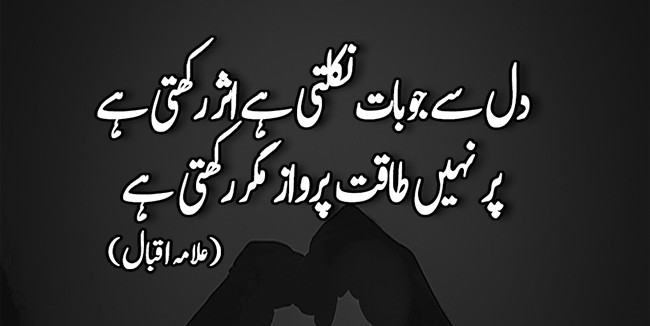
دل سے جو بات نکلتی ہے اثر رکھتی ہے
پر نہیں طاقت پرواز مگر رکھتی ہے
Dil se jo baat nikalti hai asar rakhti hai
Par nahin, taqat-e-parwaz magar rakhti hai
they have no wings, yet they can fly.
Read them on our site: Shikwa · شکوہ, and Dil se jo baat nikalti hai · دل سے جو بات نکلتی ہے.
The turn to Persian and the idea of Khudi
In 1915, Iqbal published a long poem that surprised many readers. It was not in Urdu but in Persian: Asrar-e-Khudi (The Secrets of the Self). Persian was still the language of learning across the Muslim world, from Iran and Afghanistan to Central Asia, and Iqbal wanted to speak to all of it. Over his life, more than half of his poetry was written in Persian. In Iran he is still known as Iqbal-e-Lahori, “Iqbal of Lahore”.
Asrar-e-Khudi introduced the idea at the heart of all his later work: khudi.
What is khudi?
In everyday Urdu, khudi can mean pride or ego. Iqbal gave it a new meaning: the self, the unique inner life that God gives every human being. For Iqbal, this self is not something to deny or dissolve, as some mystics taught. It is something to develop: through faith, hard work, courage, love and freedom. A person with strong khudi is self-respecting, does not beg, does not imitate blindly, and becomes a partner with God in shaping the world.
His most famous couplet says it best:
خودی کو کر بلند اتنا کہ ہر تقدیر سے پہلے
خدا بندے سے خود پوچھے بتا تیری رضا کیا ہے
Khudi ko kar buland itna ke har taqdeer se pehle
Khuda bande se khud poochhe, bata teri raza kya hai
God Himself asks you: tell me, what is your wish?
It comes from his ghazal Khirad-mandon se kya poochhun in Bal-e-Jibril.
The shaheen
Iqbal’s favourite symbol for a person of strong khudi is the shaheen, the falcon. The shaheen flies high and alone, does not build a nest, and does not eat what others have killed. It lives in the open sky and depends on no one:
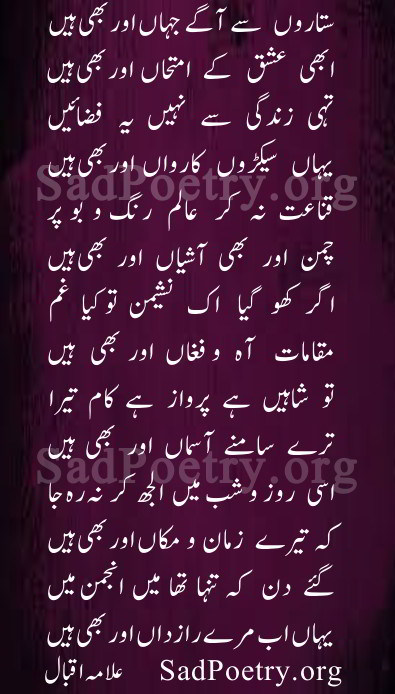
تو شاہیں ہے پرواز ہے کام تیرا
ترے سامنے آسماں اور بھی ہیں
Tu shaheen hai, parwaz hai kaam tera
Tere saamne aasman aur bhi hain
There are more skies before you.
That couplet is from the ghazal that begins “Sitaron se aage jahan aur bhi hain”, “there are worlds beyond the stars”. Read it here: Sitaron se aage jahan aur bhi hain · ستاروں سے آگے جہاں اور بھی ہیں.
In 1918 came Rumuz-e-Bekhudi (The Mysteries of Selflessness), which turned from the individual to the community: a strong self, Iqbal argued, finds its meaning inside a strong, united society. When the Cambridge scholar R. A. Nicholson translated Asrar-e-Khudi into English in 1920 as The Secrets of the Self, Iqbal’s name became known in Europe as well.
“Sir” Muhammad Iqbal and the great books
On 1 January 1923, the British government knighted Iqbal, and he became Sir Muhammad Iqbal. The same year he published Payam-e-Mashriq (Message of the East) in Persian, a reply to the German poet Goethe, whose West-östlicher Divan had been inspired by the Persian poet Hafiz. The East, Iqbal said, had its own message for the West.
In 1924 he finally gathered his Urdu poems into a book: Bang-e-Dara (The Sound of the Caravan Bell). It holds his early nature poems, his songs, Shikwa and Jawab-e-Shikwa, and much of what Urdu readers still recite today.
The books that followed are among the high points of Urdu and Persian literature:
| Year | Book | Language | What it is |
|---|---|---|---|
| 1915 | Asrar-e-Khudi | Persian | The secrets of the self: his idea of khudi |
| 1918 | Rumuz-e-Bekhudi | Persian | The self inside the community |
| 1923 | Payam-e-Mashriq | Persian | The East’s reply to Goethe |
| 1924 | Bang-e-Dara | Urdu | His first Urdu collection |
| 1927 | Zabur-e-Ajam | Persian | Persian psalms: ghazals and long poems |
| 1930 | The Reconstruction of Religious Thought in Islam | English | Six lectures on faith and modern thought |
| 1932 | Javid Nama | Persian | A journey through the heavens, guided by Rumi |
| 1935 | Bal-e-Jibril | Urdu | Gabriel’s Wing: his finest Urdu ghazals |
| 1936 | Zarb-e-Kalim | Urdu | The Rod of Moses: “a declaration of war against the present age” |
| 1938 | Armaghan-e-Hijaz | Persian and Urdu | The Gift of the Hijaz, published after his death |
Javid Nama is named after his son Javid Iqbal (born 1924), who later became a justice of Pakistan’s Supreme Court. Iqbal wrote several poems addressed to him.
The thinker of Pakistan
Iqbal was never only a poet in a study. In late 1926 he was elected to the Punjab legislature from Lahore. In 1929 he gave a series of lectures in Madras, Hyderabad and Aligarh that became The Reconstruction of Religious Thought in Islam, his main work of prose philosophy.
Then, on 29 December 1930, he presided over the annual session of the All-India Muslim League at Allahabad. In his address he said that the Muslims of north-west India, in the Punjab, the North-West Frontier, Sindh and Balochistan, should be brought together in one self-governing state. It was not yet the full idea of Pakistan as it was created in 1947, but it was one of the first clear statements, from a respected public figure, that the Muslims of India needed a homeland of their own.
He went to London for the second and third Round Table Conferences in 1931 and 1932. In the years that followed he wrote a series of private letters to Muhammad Ali Jinnah, urging him to lead the Muslims and to work for a separate Muslim state. Jinnah later said that Iqbal’s ideas had led him to the same conclusion. This is why Pakistan calls Iqbal Mufakkir-e-Pakistan, the Thinker of Pakistan.
Spain, Afghanistan and the last years
In January 1933, Iqbal visited Spain. He lectured in Madrid and prayed in the great mosque of Cordoba, which had not seen Muslim prayer for centuries. The visit gave Urdu one of its greatest poems, Masjid-e-Qurtuba, published in Bal-e-Jibril. Later that year he travelled to Afghanistan at the invitation of King Nadir Shah, to advise on education.
From January 1934 his health failed. His voice weakened, his eyesight dimmed, and he could no longer practise law. Yet these were the years of Bal-e-Jibril and Zarb-e-Kalim, and he kept writing almost to the end. Even late in life he refused to let his readers give up:
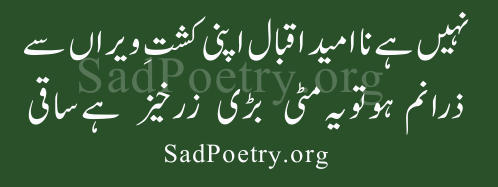
نہیں ہے ناامید اقبالؔ اپنی کشت ویراں سے
ذرا نم ہو تو یہ مٹی بہت زرخیز ہے ساقی
Nahin hai na-umeed Iqbal apni kisht-e-veeran se
Zara nam ho to ye mitti bahut zarkhez hai saqi
with a little moisture, saqi, this soil is very fertile.
Read it here: Nahi hai na-umeed Iqbal · نہیں ہے ناامید اقبال.
Allama Iqbal died in Lahore on 21 April 1938, aged 60. He is buried beside the steps of the Badshahi Mosque, in the garden between the mosque and the Lahore Fort. His tomb is guarded day and night, and the changing of the guard there is one of Lahore’s best-known sights.
His legacy
Nine years after his death, Pakistan came into being, and Iqbal became its national poet. His birthday, 9 November, is Iqbal Day. It is a public holiday again since 2022, after a break from 2015. Schools hold speeches and recitations, and his tomb is visited by the country’s leaders.
His influence reaches far beyond Pakistan:
- In India, Saare jahan se achchha is still one of the best-loved patriotic songs.
- In Iran and Afghanistan, his Persian poetry is read as part of their own literature, under the name Iqbal-e-Lahori.
- In Urdu poetry, he widened the ghazal and the nazm beyond love and loss to faith, history, politics and philosophy, without losing their music.
Above all, his message is still personal. Every generation of young readers finds in Iqbal the same call: you are not small, your life is not fixed, and the sky is not the limit:
ستاروں سے آگے جہاں اور بھی ہیں
ابھی عشق کے امتحاں اور بھی ہیں
Sitaron se aage jahan aur bhi hain
Abhi ishq ke imtihan aur bhi hain
there are more tests of love still to come.
Where to start reading Iqbal
If you are new to Iqbal, start with these, all on SadPoetry.org in Roman Urdu and Urdu:
- Sitaron se aage jahan aur bhi hain: Iqbal’s call to keep rising.
- Shikwa, then Jawab-e-Shikwa: the complaint and the answer.
- Tere ishq ki inteha chahta hoon: Iqbal the love poet.
Or browse all of them on the Allama Iqbal poetry page · علامہ اقبال کی شاعری.
Sources
- Iqbal Academy Pakistan, Chronology of Allama Iqbal’s life (allamaiqbal.com).
- Frances W. Pritchett, An Iqbal Chronology, Columbia University (franpritchett.com).
- Lincoln’s Inn archives, “The spiritual father of Pakistan” (lincolnsinn.org.uk).